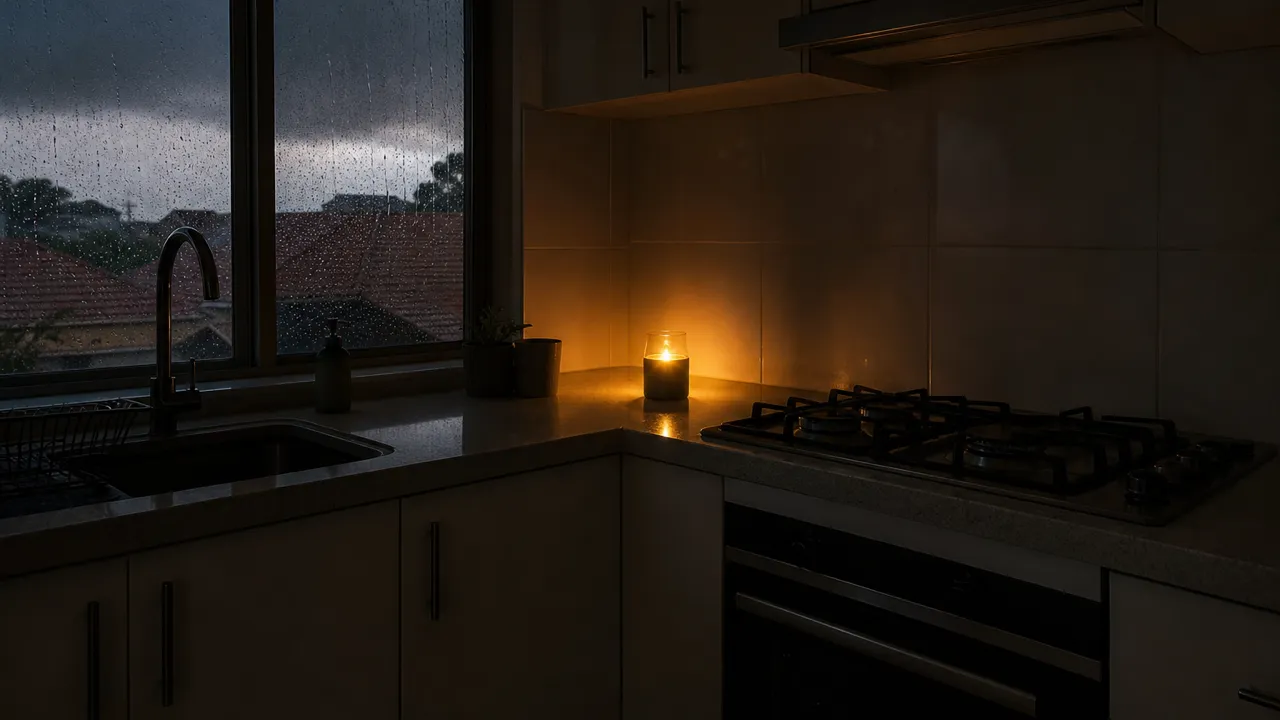
The morning after that east coast low a couple of winters back, I took eleven calls before ten o'clock. Woonona, Bulli, Thirroul, Corrimal, all up the northern line. Two fridges, a wall oven, an induction cooktop, a washing machine stuck mid-cycle and a rangehood that had gone completely dark.
A bloke in Bulli said the same thing four of them said: it was fine the whole time the power was off, and it died when the power came back.
He was right, and that is the part most people have backwards.
The damage happens on the way back up
An outage on its own is harmless to almost everything in your kitchen. The trouble is the restoration. When the network brings a feeder back, and especially when it brings it back after a fault, the voltage does not step neatly up to 230 and hold. You get a spike, sometimes a few of them, sometimes a couple of failed reclose attempts a second apart.
Older appliances shrugged that off because there was nothing in them to hurt. A motor, a thermostat, a timer. Everything built in the last fifteen years has a control board in it, and a control board is a circuit board with a power supply on it, and those are what let go. It is why I replace far more boards after a storm week than motors.
The other one is compressors. A fridge compressor that gets cut mid-run has pressure still equalising in the system for a few minutes. Bring the power back inside that window and it tries to start against a head of pressure it cannot shift, draws hard, and either trips its overload or cooks the start winding. Do that three or four times in one evening of flickering supply and you can lose a compressor that had years left in it.
What I do at my own place
When the power goes off and it is obviously a storm rather than a five-minute blip, I walk around and switch things off at the wall. Oven, cooktop, dishwasher, washing machine, dryer, microwave, TV. Two minutes of work.
The fridge and freezer I leave plugged in, because their own controls handle the restart and I would rather not be the one who forgot to switch them back on. But when the lights come back, if the fridge does not start on its own, leave it alone for ten minutes before you go poking at it. Most modern units have a built-in delay for exactly this reason. The old ones do not, and a good ten minutes lets the pressure settle.
Then switch the rest back on one at a time, a minute or so apart, rather than the whole house at once.
Whether it is worth fitting surge protection is a fair question and the answer is usually yes, but be clear about which kind. A powerboard with surge protection at the outlet is a plug-in item that anyone can use. A surge diverter at the switchboard, which is the one that actually protects the hardwired stuff like the oven and the cooktop, is fixed wiring, and fixed wiring in NSW is only ever touched by a licensed electrician. Not a handy neighbour and not us either. We fix appliances, we do not work in switchboards.
If you are on the Illawarra network, Endeavour Energy's outage map is worth having bookmarked. Knowing whether it is the street or just your place saves an hour of guessing, and it tells you whether to expect more of the same overnight.
Working out what actually broke
The next morning, go around and turn things on before you need them. A fridge that is quietly not cooling gets discovered at 6pm on a Sunday with a full load of food in it, which is the worst way to find out.
Some things that turn up after a night of flickering supply:
An oven or cooktop with a blank display and no response is usually a blown board or, if you are lucky, a tripped circuit. Check the switchboard first, because sometimes the whole answer is a breaker that needs resetting. If it trips again the moment you reset it, stop, and leave it off.
A washing machine that stopped mid-cycle and now shows an error code is often just confused rather than broken. Turn it off at the wall, wait five minutes, turn it back on and start a fresh short cycle. That clears a surprising number of them. If the code comes back, write it down, because it saves diagnostic time.
A fridge running but not getting cold, or a freezer that has climbed, is either the board or the compressor and it needs looking at quickly. We go through the diagnosis in freezer not freezing and fridge cooling but the freezer is not.
Anything that smells hot, buzzes, or trips the safety switch when you turn it on goes off at the wall and stays off until someone qualified has looked at it.
The food question
While you are sorting the appliance out, be sensible about what is in it. A closed fridge holds a safe temperature for around four hours. A full freezer will hold for a day or two if you keep the door shut, and a half-empty one nowhere near that. Keep the doors closed and do not keep opening them to check, because checking is what costs you the food.
Anything that has been above five degrees for more than four hours, throw out. It is not worth the week you will spend regretting it.
Getting it paid for
Two things people forget. Home and contents policies often cover appliance damage from a power surge, and the claim usually needs a technician's report saying what failed and why. We write those. Ring us before you throw the machine out, because a dead appliance in a skip is not evidence.
The other is that a failure at four years old on an appliance that should have lasted a decade is not automatically your problem, even out of warranty. Consumer guarantees do not stop at the manufacturer's warranty period, and a surge-tolerant power supply is not an unreasonable thing to expect.
What we can do
We repair fridges, ovens, cooktops and washing machines on every major brand, from Helensburgh and the northern suburbs through Wollongong and down past Kiama to Nowra. Storm weeks get busy, so ring early rather than waiting to see if it sorts itself out.
The technician diagnoses the fault and quotes before starting. The assessment fee is $125 across the Illawarra and $145 further out on the South Coast, and the report doubles as your insurance documentation if it comes to that. Book a repair or call 02 4229 3777.