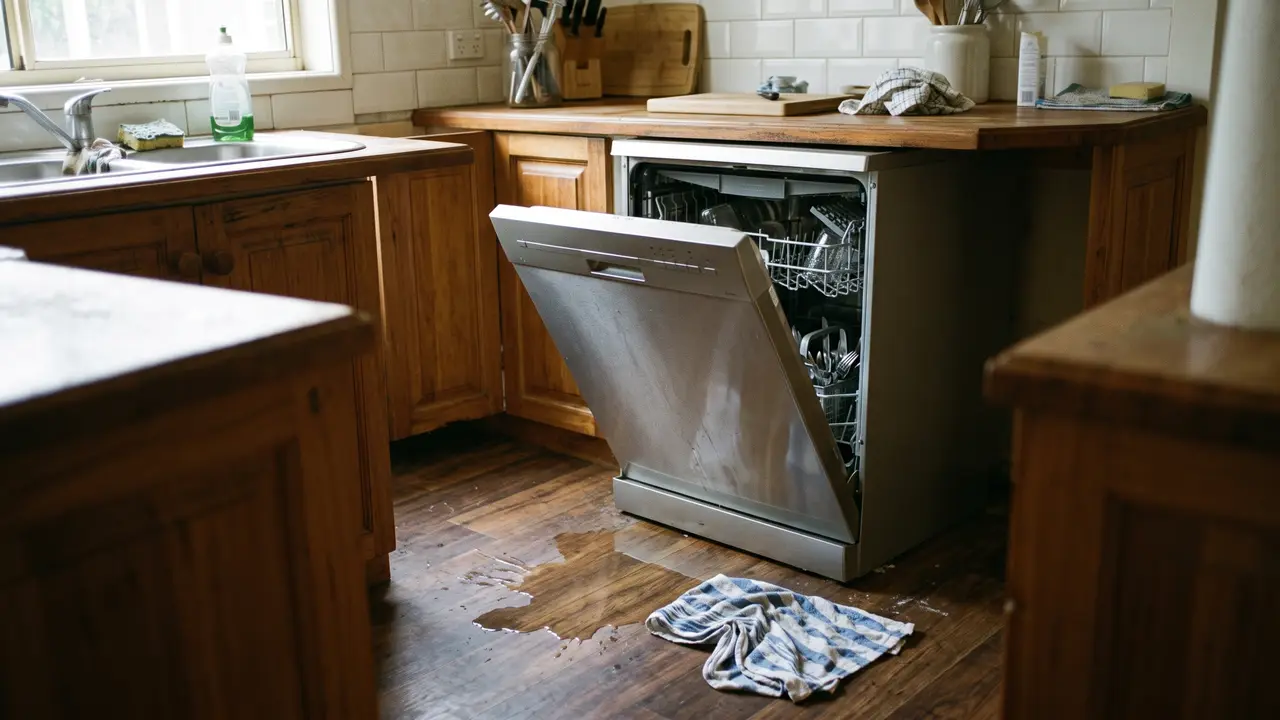
The worst dishwasher leak I ever saw did not show up as a puddle. It showed up as a kitchen kickboard that had gone soft, in a house in Dapto, about four months after the leak started. By the time I got there the particleboard floor of the cabinet next door had swollen up like a sponge and the owner was ringing a cabinetmaker before she rang me.
The leak was a hose clamp. A hose clamp that had let go on a fitting behind the machine, dripping perhaps a cup a day into a spot nobody could see.
That is the thing about dishwasher leaks, and it is why I want to write this one differently from the others. The fault is usually small. The damage depends entirely on where the water goes, and where the water goes tells you, more reliably than anything else, what let it out.
Water in front of the door
Start with the good news. A puddle on the floor directly under the door, appearing during or right after a wash, is the one you can usually fix yourself, and it is nearly always one of three things.
The first is suds. A dishwasher is designed for detergent that barely foams, and if somebody has put dishwashing liquid in it, or a rinse-aid dispenser has cracked and is dumping the lot in at once, the machine fills with foam and the foam finds its way out past the bottom of the door. You will see it: a clean, slightly slimy puddle and a machine that looks like a bubble bath through the glass, if it has glass. Run it empty with nothing in it a couple of times and it clears. I have already written about what goes in the dispenser and what does not, so I will leave it there.
The second is the door seal. There is a rubber gasket around the tub opening and often a separate low strip along the bottom of the door, and on a machine over five or six years old the bottom one goes hard and flattens. Water thrown at the door by the lower spray arm runs down the inside, hits a seal that no longer seals, and out it comes. Run your finger along the bottom strip. If it is stiff, cracked, or has a section that sits lower than the rest, that is it. A bottom door seal is a cheap part and on most machines it slides into a channel, no tools.
The third is something in the way of the spray arm. A tall pot handle, a chopping board leaned against the front of the bottom rack, a lid standing up. The arm hits it, the water jets straight at the door instead of across the dishes, and the door seal, which was fine for a normal wash, cannot hold a firehose. Look at how the machine was loaded when it leaked. If it only leaks on some loads, this is why.
None of those three are worth paying me for. All three are worth an hour of your time before you ring anyone.
Water at the side, or wet under the bench next door
This is where the Dapto job lived. Water that comes out to one side, or that you find by opening the cupboard beside the machine and finding the floor of it damp, is coming from a hose or a connection rather than from the tub.
Behind and beside a dishwasher there are three lines: the inlet hose from the tap, the drain hose to the sink, and the fill valve where the inlet meets the machine. A clamp lets go, a hose chafes through where it bends around the cabinet edge, a fill valve body cracks. They all drip rather than gush, and they drip into the cabinet base where you will not see it.
If you have water in the cupboard next to the dishwasher, pull the kickboard off. You can usually see the drip, or the trail it has left, with a torch. What you do about it depends on which side of the machine the leak is on. The fill valve, the internal hose and the pump are appliance work and they are my job. The tap under the sink and the braided hose from it are plumbing, and in NSW you need the right licence or certificate to do plumbing, draining or gasfitting work, so if the leak is at the tap, ring a plumber and not me. I get asked, and the answer is no.
Water underneath, and the machine keeps running
The bad one, and the one I am most careful about.
If water is coming out from under the machine itself, from the middle rather than a side, it is coming from the sump. That is the low point of the tub where the pump and the heater sit, and there are seals there between the tub and the pump body. When one lets go, water runs out of the sump every time the machine fills.
Some dishwashers have a float or a sensor in the base tray for exactly this, and they will stop and show a code, or just refuse to start, when it fills. Which sounds like a fault and is actually the machine saving your floor. If yours has stopped dead and there is water in the base, that is what has happened.
Whether it is worth fixing comes down to which seal and how old the machine is. A pump seal or a sump seal on a machine under ten years is a reasonable job. A cracked sump on an older machine, or a tub that has rusted through at a seam, which I do see on coastal kitchens between Austinmer and Shellharbour where the salt air gets in behind the panels, is the end of the machine. I will say so at the assessment rather than order a part on the chance.
The overfill
One more, because it does not fit the pattern. Water everywhere, all at once, mid-fill, on a machine that was fine last week. That is a fill valve that has stuck open, or a float switch that has stuck down, and the machine has kept taking water past the point where it should have stopped. Turn it off at the wall and turn the tap under the sink off, and do not run it again until it is looked at. This one is not going to sort itself, and the second time it does it, the water will be in the neighbour's cupboard.
What it costs the house, not the machine
The reason I am blunt about this fault where I am relaxed about most others is that a dishwasher leak is the only common appliance fault where the appliance is not the expensive part.
A bottom door seal is cheap. A hose clamp is nearly nothing. A pump seal is a moderate job. A swollen kitchen cabinet base is a cabinetmaker and, if it has gone through the floor, it can be a builder. So if you have a leak, even a small one, and you cannot find where it is coming from in that first hour, do not put a towel down and give it a month. That is how the Dapto kitchen happened.
And on the machine itself: if it is out of the printed warranty and you get told there is nothing to be done, that is not necessarily the end of it. Under Australian Consumer Law your consumer guarantees are automatic and cannot be taken away, the printed warranty is an extra promise on top of them, and one of the guarantees covers repairs and spare parts being available for a reasonable time after purchase. A three year old dishwasher with a leaking sump is exactly the kind of case those guarantees exist for.
Booking a repair
We repair dishwashers on every major brand across Wollongong, the Illawarra and the South Coast, freestanding and integrated, and if the machine is also draining slowly, a dishwasher that will not drain is worth reading first because a partial blockage can push water out past the door too.
We are a family-owned authorised repairer for all the major brands we service and carry parts for them, so we handle this in warranty and out. If yours is still under warranty, have your proof of purchase handy when you book. The assessment fee is $125 across the Illawarra and $145 further out on the South Coast, and you get the repair price before any work starts. Book a repair or call 02 4229 3777.
Before you do, pull the kickboard and look. Where the water is will tell you most of it.