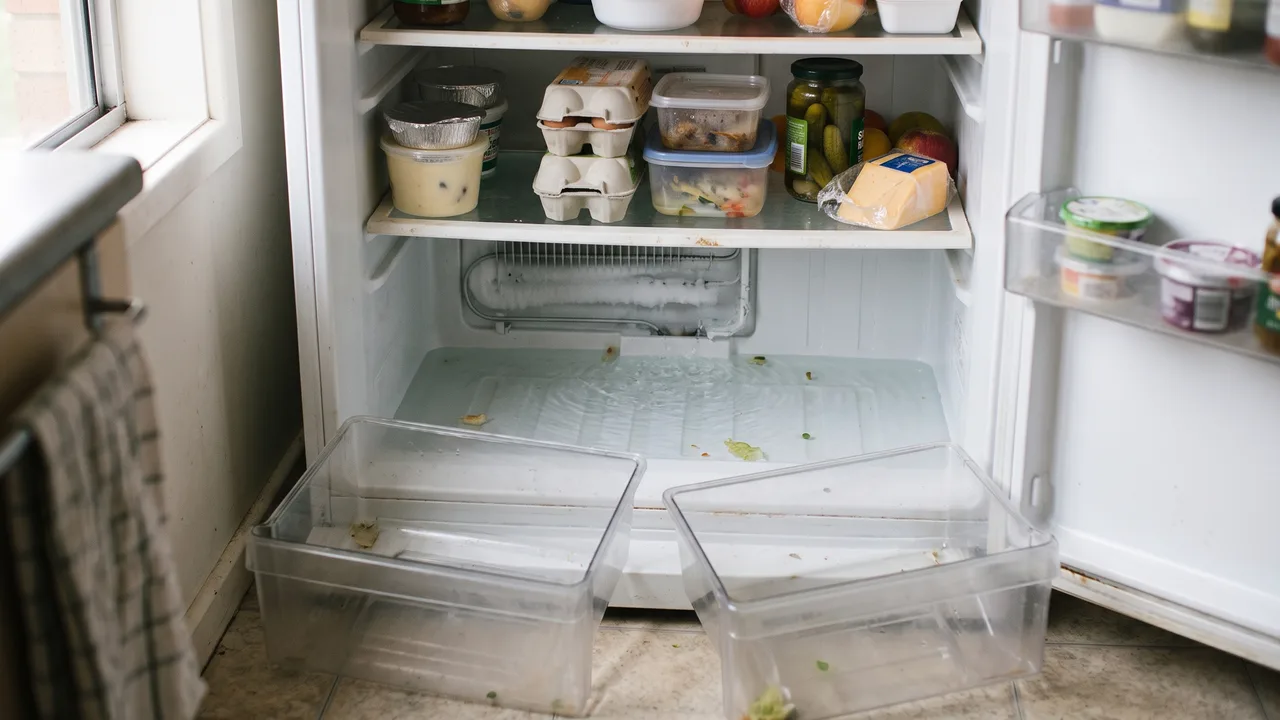
A bloke in Dapto had been mopping the bottom of his fridge with a tea towel every second morning for the better part of a year. He assumed a drawer had cracked. His wife assumed one of the kids kept leaving a drink bottle on its side. Neither of them ever looked at the back wall of the fridge, because why would you.
There is a hole down there. About the size of a pencil, in the middle of the little gutter where the rear wall meets the floor of the fridge compartment, and on his machine it was full of a grey plug of gunk that had taken about four years to build up. Warm water, two minutes, done. He had been doing that tea towel for a year.
That is comfortably the most common cause of water inside a fridge, and it is worth understanding why, because once you know what that hole does the whole thing makes sense instead of feeling like a fault.
Your fridge is supposed to make water
Every frost-free fridge builds ice on its evaporator, which is the cold coil hidden behind the back wall of the freezer. If it kept building, the freezer would pack solid, so a few times a day a small heater warms that coil, melts the frost off it, and the machine goes back to cooling.
That melt water has to go somewhere. It runs down into a gutter, out through the drain hole, down a tube inside the cabinet, and into a black tray sitting on top of the compressor at the back. Down there the compressor is warm and the water evaporates away, which is the whole design. You are never meant to see any of it.
So when water turns up inside the fridge, nine times out of ten nothing is leaking. Something is stopping water that was always going to exist from getting to where it was always going to go.
Where the water is decides the fault
Before you touch anything, work out which of these you have, because they are four different problems and only two of them are yours.
Water pooling under the crisper drawers, or a wet patch on the glass shelf above them, is the drain.
Water on the floor at the back of the fridge is the tray, or a water line.
Water on the floor at the front, running out under the door, is usually the drain overflowing so badly it has run out the front instead, or a door that has not been shutting.
A sheet of ice on the back wall of the freezer, or the fridge going warm and then flooding a day later, is a defrost fault and not a drain problem at all.
Clearing the drain, and the thing not to do
If it is under the crisper, pull the drawers right out and look at the back wall where it meets the floor of the compartment. There will be a shallow channel and a hole in it. On some models it is behind a small removable cover, on a few it sits under the bottom shelf rather than below it.
Boil the kettle, let it cool to somewhere warm rather than hot, and pour a cup slowly into the hole. If it drains away, it was never blocked. If it backs up and sits there, you have found it.
What is in there is a mix of food debris, mould and usually a plug of ice. Warm water will shift most of it, sometimes over three or four goes. A soft, blunt plastic tube works if you need to persuade it, and a length of the plastic tubing from a fish tank is honestly the perfect tool.
Do not push a skewer, a wire, a coat hanger or a screwdriver down there. The drain tube is thin plastic and it runs past the foam insulation and, on some designs, past refrigerant lines. Punch through it and the repair goes from a cup of warm water to a job that is not economic on most fridges. I have seen it twice, and both times the owner had watched a video.
The other thing to know is that a lot of models have a small rubber flap on the end of the drain tube, down in the compressor bay at the back. It is there to stop warm air being drawn up the tube. It also collects sludge and it perishes. If you have cleared the hole from inside and it still backs up, that flap is where I would look next, and that is behind the back panel.
Water on the floor, which is a different set of causes
If the puddle is outside the fridge rather than inside it, start behind the machine.
The drip tray sits on or beside the compressor. It cracks with age, and more often it gets knocked out of position when the fridge is dragged out for a clean and then pushed back. Water lands next to it instead of in it, runs across the floor, and the owner spends a fortnight looking for a leak.
If the tray is overflowing rather than misplaced, the fridge is producing more melt water than it should, and that points back at a door being left ajar, a failed seal letting warm humid air in all day, or a defrost cycle running too often. Illawarra summers are humid enough that a marginal door seal shows up here first. There is a proper walkthrough with the paper test in replacing a fridge door seal.
And if the fridge is plumbed for ice and water, that is a whole other candidate. The supply is usually a thin push-fit plastic line, and where it gets crushed against the wall behind the fridge it eventually splits, or the fitting works loose. That is a slow drip that shows up as a puddle metres from where it started. The fridge's own valve and internal lines are ours. Anything on the house side of the tap under the sink is plumbing, and that is a licensed plumber's job rather than a Saturday one.
Ice on the back wall, then a flood
This one is not a drain problem even though it looks like one.
If the rear wall of the freezer has a solid sheet of ice on it, or the fridge compartment has been getting warmer over a week and then suddenly there is water everywhere, the defrost system has stopped working. The heater has failed, or the sensor that tells it when to run has, or on older machines a mechanical defrost timer has stuck. Frost builds until it blocks the airflow path, the fridge side stops getting cold air, and when you finally open it all up the whole lot melts at once.
The symptom people notice first is usually a warm fridge with a freezer that still seems fine, and that pattern is worth reading up on in why the fridge is warm when the freezer still works. It is a repair rather than a maintenance job, but it is a normal one and generally worth doing.
The water that is not a fault at all
Worth saying, because I get called out for these.
Droplets or a light film of water on the back wall of the fridge compartment, appearing and disappearing over the course of a day, is the machine working correctly. That surface goes through warm and cold phases and it will sweat.
Water in the bottom of the crisper drawers is very often the vegetables. Lettuce and celery put out a lot of moisture and the drawer is designed to hold it in. Most crispers have a slider on the front that opens a vent, and half the fridges I see have it shut on both drawers because nobody knew what it did. Open it a bit.
Condensation across the inside of the glass shelves in a Wollongong summer, on a fridge that gets opened twenty times an afternoon, is humidity and a busy household, not a fault.
While you have got it pulled out
If a fridge is icing up or running long because the drain is blocked and the seal is soft, it is costing you money every day. Pull the coils clean while the machine is out from the wall, and if you are weighing up whether the old one is worth keeping, the running-cost figures on the Energy Rating label are the honest way to compare it against a new one. There is more on that sum in the five faults we see most on fridges.
The other thing to check while you are in there is the temperature. The NSW Food Authority's food safety key tips put the number at below 5°C, and a fridge that has been quietly drifting up because its airflow is choked with frost is a food safety problem before it is a puddle problem. A cheap fridge thermometer on the middle shelf overnight will tell you.
We repair fridges and freezers on every major brand across the Illawarra and South Coast, and the full fault list is on the fridge repair page. The technician diagnoses and quotes before starting, and the assessment fee is $125 across the Illawarra and $145 further out. Book a repair or call 02 4229 3777.
Before you ring about water, though, do the warm water down the hole. It genuinely fixes a good third of these and it takes less time than the phone call.