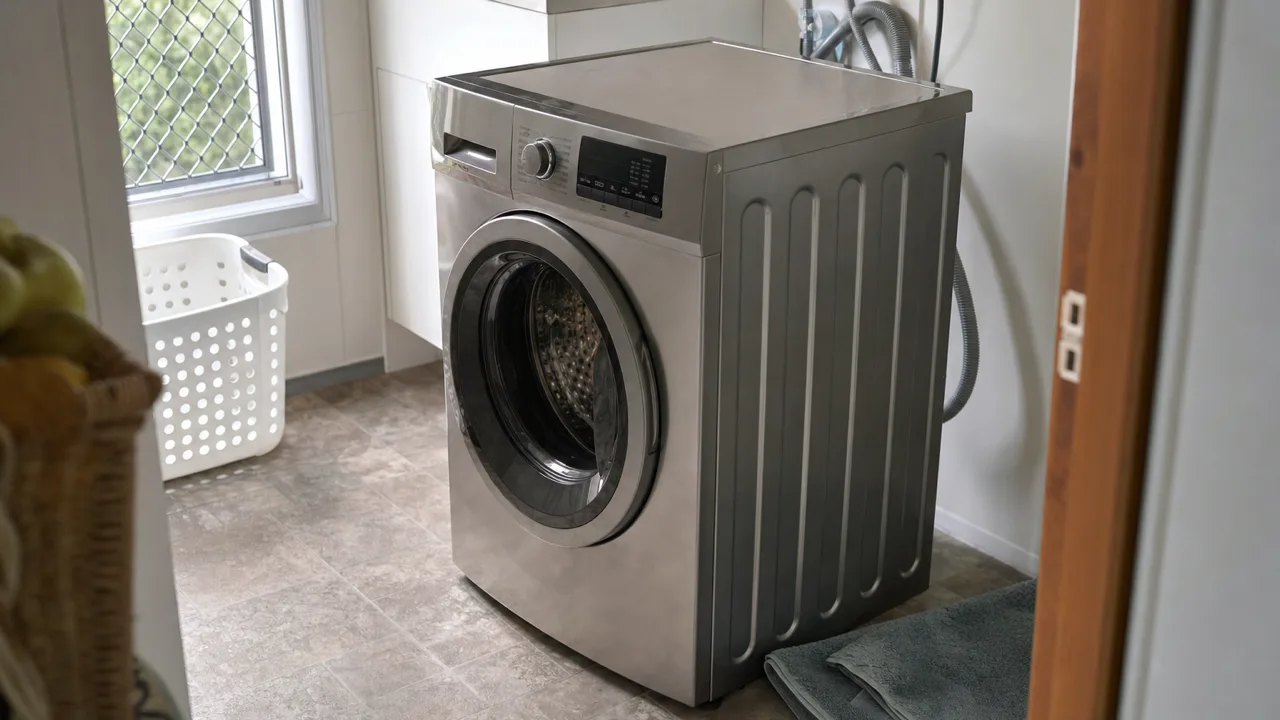
A bloke in Corrimal rang me because his washing machine had moved. Not vibrated. Moved. It had crept about half a metre out from the wall over the course of a year, dragged the drain hose with it, and left two long gouges in the vinyl where the feet had walked. He had been shoving it back into the corner every few weeks and had stopped thinking of it as a fault.
It was a fault. The rear feet had never been wound down properly at delivery, the machine had been rocking on two corners since 2019, and the bearings were on the way out from all that rocking. If he had rung me the first time it thumped, it would have been a ten minute levelling job.
That is the thing about washing machine noise. Nobody rings about it early. They ring when the noise has turned into a smell or a leak or a load that will not spin, and by then the cheap fix has usually turned into an expensive one.
Do this before you read any further
Turn the machine off at the wall. Open the door, put a hand flat on the inside of the drum at the top, and spin it. Then grab the drum at the front edge, twelve o'clock, and pull it up and down and side to side.
You are listening and feeling for four things, and each one points somewhere different.
A drum that spins freely, silently, and does not budge when you rock it is mechanically fine. Whatever your noise is, it is not the bearings, and that is the good news you were hoping for.
A drum that rumbles or grates as it turns, like there is sand in it, is bearings. So is a drum that lifts or drops more than a couple of millimetres when you pull on it, or one that lets you feel the seal drag.
A drum that clunks once or twice per revolution has something loose inside the outer tub, sitting between the drum and the tub wall.
And a drum that is perfectly quiet by hand but the machine hums without doing anything is not a drum problem at all.
Thumping and walking: the boring one, usually
If the noise only happens on the fast spin and the machine bangs its way around the laundry, start with the least interesting possibilities, because they are the likely ones.
Load distribution comes first. A doona, a single bath mat, or three towels that have wound themselves into one rope will throw a drum badly out of balance. Modern machines try to correct it by stopping, redistributing and having another go, which is why a load with a doona in it takes an hour and a half instead of fifty minutes. Open the door, pull the load apart, spread it around, and run a spin on its own.
Then the feet. Every washing machine has adjustable feet and most of them have a lock nut. Push down on each corner of the machine in turn. If any corner drops, that foot is short. Wind it out until the machine sits solid on all four, then tighten the lock nut against the body so it stays there. On a timber floor in one of the older weatherboard places up through Bulli and Thirroul, this matters more than it does on a slab, because the floor itself flexes and amplifies everything.
The one people forget is transit bolts. New machines ship with three or four big bolts through the back panel that clamp the drum solid so it cannot swing in the truck. They must come out before the first wash. A machine still running on transit bolts makes a hard, metallic bang and will wreck itself in a few months. If yours was delivered and installed by the retailer's contractor and it has thumped from day one, look at the back panel before you look at anything else.
Grinding and roaring: bearings
This is the one everybody dreads and it is worth being straight about.
Drum bearings sit behind the drum and carry it. They fail slowly. It starts as a faint roar on the spin cycle that rises and falls with the drum speed, and over six or twelve months it turns into a noise like a small aircraft in the laundry. The tell is that the noise tracks the spin speed exactly. Slow spin, low roar. Fast spin, loud roar. Nothing else in the machine behaves that way.
The cause, most of the time, is water. The drum bearing sits behind a seal, the seal wears, water gets past it, and the bearing rusts. Detergent residue and long-term rocking speed it all up. So do the rear feet that were never wound down, which is how the Corrimal machine got there.
Whether it is worth fixing depends entirely on the machine. On a lot of front loaders the bearings are pressed into a two-piece outer tub, which means the tub splits, the seal and both bearings go in, and it is a solid half day on the bench. On some brands the outer tub is a single welded plastic unit and the bearing is not serviceable at all, so the repair is a whole new tub assembly and the arithmetic stops working. On a top loader with a serviceable transmission it is often a different and better story.
I will not quote a bearing job over the phone, because the answer swings that hard between models. What I will do is tell you honestly which of those three situations you are in once I have the model number, and if it is the third one I will say so. Our note on weighing a repair against a replacement sets out how we do that sum, and CHOICE has a reasonable reference on how long appliances should last if you want a second opinion on whether yours has had a fair run.
Rattling and clunking: something is in there
A hard clunk once or twice per drum revolution, or a rattle you can hear during the gentle tumble as well as the spin, usually means a foreign object has escaped through one of the drum holes and is now rolling around in the gap between the drum and the outer tub.
Underwires are the classic. Coins, hair clips, screws left in a work shirt pocket, the little plastic collar stays out of a business shirt. They get in through the holes in the stainless drum and they cannot get back out.
Sometimes one will find its way to the drain pump filter on its own and you will hear the noise stop. More often it sits in the tub and grinds a groove in the plastic, or worse, works itself into the drum seal and starts the exact water leak that kills the bearings. That is the reason not to leave it. A five minute job now versus the big job in two years.
Getting it out means taking the heater or the front panel off on most machines, and that is our end of it, but it is a cheap visit and a quick one. While the filter is off it is worth clearing that anyway. Our guide to a washer that will not drain or spin walks through the filter properly.
Humming with nothing happening
If the drum is quiet by hand but the machine sits there buzzing at the point where it should be draining or spinning, that is not mechanical noise. That is a motor or a pump trying to turn something it cannot turn.
Nine times out of ten it is the drain pump, blocked or seized, and the hum is the impeller straining against a coin. Clear the filter first. If it hums during the spin instead, and the drum will not accelerate, you are looking at the motor, the drive belt, or on a direct drive machine the rotor position sensor.
One thing worth doing before you book anything: check the floor under the machine. If there is water there as well as noise, deal with the leak in the same visit rather than two. There is a full run through the usual sources in tracing a washing machine leak.
What actually keeps a machine quiet
Not much, and none of it is difficult.
Wind the feet down properly and check them once a year, because floors move and lock nuts loosen. Do not run half loads of heavy items, because one wet towel spinning alone at 1400 rpm is worse for the bearings than a full drum. Clear the pockets, because underwires and coins are the single most preventable cause of the whole thing. And leave the door ajar between washes so the seal dries, which slows down the seal wear that lets water into the bearing in the first place.
If you are replacing rather than repairing, the Energy Rating Label covers water as well as power, and the gap between an old machine and a new one is bigger on water than most people expect. The full fault list for washers is on our washing machine repair page.
We are across the Illawarra and down the coast most days. The technician diagnoses the fault and quotes it before starting, and the assessment fee is $125 across the Illawarra and $145 further out. Book a repair or call 02 4229 3777.
Have the model number ready. On a noise call it decides whether the bearing job is a half day or a no, and I would rather tell you that on the phone than in your laundry.