The dryer that put a smell through every towel in the house
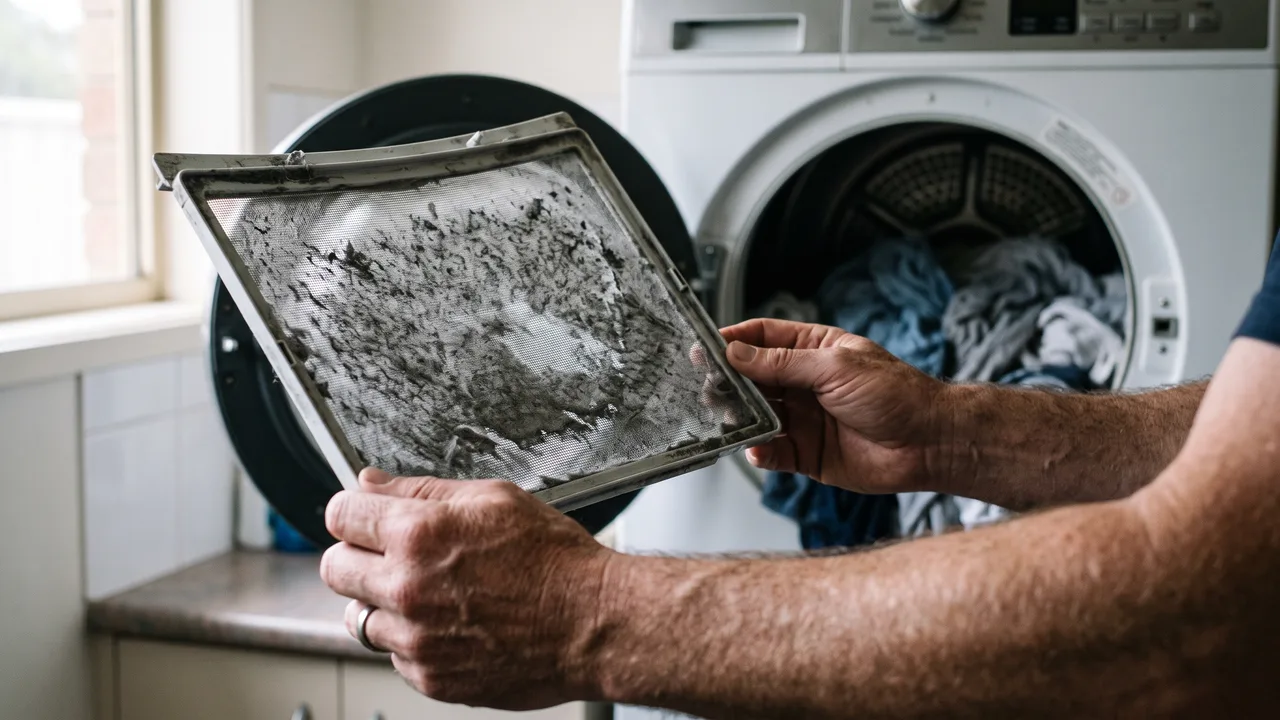
A woman in Oak Flats rang me in July about a smell she had been chasing for two months. She had washed the towels three times. She had bought different detergent. She had pulled the machine out and cleaned behind it, twice, and by the time she rang me she had half convinced herself something had died in the wall.
It was the dryer, and it was not broken. The lint filter had a coat of fabric softener wax on it that you could not see and could not feel, and every load was being dried through a filter that air could barely get through. Hot, slow, damp air sitting in a closed-up garage laundry all winter. Two minutes under the hot tap with a nail brush and the smell was gone by the weekend.
I bring that up because dryer smell calls almost never turn out to be the thing the owner suspects. And one of them, the burning one, is genuinely worth stopping the machine for. So it is worth being able to sort them before you ring anyone.
Work out where the smell is, not what it smells like
People ring me and describe the smell. Sour, musty, chemical, like a wet dog. Honestly, it does not help much, because half of that is what your nose does with damp.
What helps is where it is.
Open the door on a cold machine and put your head in. Does the drum itself smell, right there? Or does it only smell once a load has run and the room has warmed up? Or is it the clothes, still smelling an hour later on the bed?
Three different answers, three different faults, and I will take the room one first because it is the most common by a mile and the least likely to be the dryer's fault at all.
The damp smell is usually the room
If your laundry only smells in winter, and it smells worse the day after a big drying day, the dryer is the cause but the machine is fine.
A dryer's whole job is to take water out of clothes and put it somewhere. On a vented machine, somewhere is the room, unless there is a duct going outside and the duct is actually clear. A few kilos of wet washing carries a surprising amount of water, and in a small closed laundry with the door shut, that water goes onto the coldest surface it can find. Behind the machine, up in the corner of the ceiling, along the bottom of an external wall.
Then it grows something. NSW Health's factsheet on mould in the home is blunt about the conditions it needs, which are wet or moist areas without adequate ventilation, and equally blunt that the spores can set off a runny nose, itchy eyes and wheezing, and can trigger an asthma attack in someone who has it. That is not a dryer repair. That is a window, a vent, or an exhaust fan.
Half the laundries around here are in a garage, and a garage from May through August is a cold concrete box with the roller door shut. Woonona, Oak Flats, anywhere with a brick garage on the low side of the block. Those are the rooms this happens in.
If you cannot duct it outside and cannot ventilate the room, that is genuinely the argument for a different machine rather than a repair, and I have set out the trade-offs in vented, condenser or heat pump.
Condenser tanks and the water nobody empties
Condenser and heat pump dryers do not put the water in the room. They collect it, which is better, right up until somebody stops emptying it.
The tank is usually a slide-out drawer at the top or the bottom. Full of lukewarm water, fibres and whatever was on the clothes, sitting in a warm cabinet. Leave it a week and it goes off. Leave it a month, which people do over summer when the dryer is not used, and it goes properly off, and the first load in autumn pushes that smell straight through the machine.
Empty it after every load, and once a season pull it right out and wash it with hot soapy water. Same for the little sump the tank sits in if your model has one you can reach.
The other one on heat pumps is the condensate pump and the fine filter in front of the evaporator. Lint that got past the main filter turns into a grey sludge in there, and sludge smells. Most models have a second filter that pulls out and rinses. Most owners have never found it. Read the manual, or ring us and we will tell you where yours is.
When the smell is on the clothes and it came from the washer
This is the one that gets misdiagnosed constantly, and the tell is simple.
If clothes come out of the washing machine smelling faintly sour, and then the dryer heats them and the smell is suddenly obvious and set into the fabric, the dryer did not do it. The dryer baked in something that was already there. Wash a load and smell it wet, straight out of the washer, before it goes anywhere near the dryer. That one test settles it.
Front loaders are usually the culprit, particularly if the door gets shut after every wash and everything runs cold. Our walkthrough on getting the smell out of a front loader covers the seal lip, the drawer and the filter, and doing that will fix the dryer smell too because the dryer was never the problem.
The other version is washing left in the machine overnight. Everybody does it. But a load that has sat wet for twelve hours has started to go, and heat sets it. Rewash it. Do not dry it.
The filter thing, because almost nobody knows it
Back to the Oak Flats machine, because this one is worth doing tonight.
If you use fabric softener, or dryer sheets, or both, the residue builds an invisible film on the lint filter mesh over a couple of years. It is not fluff. You cannot see it, and running your hand over it feels normal.
Take the filter out and hold it under a running tap. Water should pour straight through. If it beads on the mesh and pools in the frame, the filter is sealed shut, and your dryer has been trying to breathe through it for months. That is why the cycles got longer, that is why the machine runs hot, and that is where the damp smell comes from.
Wash it with hot water, a drop of dishwashing liquid and a soft nail brush until water runs through freely again. Do it every few months. It costs nothing and it is the single most useful thing in this whole article.
Choked airflow is also how dryers die, which is a separate conversation covered in a dryer that runs but will not heat.
Burning smells: which one means stop
Right. This is the part where I stop being relaxed about it.
A hot, dusty, scorched sort of smell, like an old bar heater the first time you switch it on in May, is lint. Lint sitting on or near the element, or packed down into the cabinet where you will never see it. Common as anything, caused by years of filter neglect, and fixable. It is also, and I am not being dramatic, the state a dryer is in shortly before it becomes a fire. Do not keep running it and hoping.
Hot rubber is different and much less alarming. Usually a drive belt slipping on a drum that is not turning freely, or a belt that has begun to shred. If the drum sounds wrong too, or the cycle ends with the clothes barely warm and still sitting in a heap on one side, that is the story in the dryer hums but the drum will not turn.
Then there is the acrid one. Hot plastic, or that faintly fishy smell that hot insulation gives off. That is a terminal or a length of wiring getting hot, and around here it is very often corrosion on the element terminals after years of salt in the air. Turn the machine off at the wall. Not at the end of the cycle. Now. Then ring somebody.
Same applies if the smell comes with a tripping circuit, a hot spot on the cabinet, or scorching around the plug. And while you are stopped, it costs nothing to put the model number into the product recalls register, because clothes dryers turn up on it more often than people realise.
Marks on clothes, which is a different fault
Sometimes there is no smell at all, just damage, and this is where the model and the drum matter.
Grey or black streaks along the fabric, worst on light-coloured cotton, usually mean the felt seal at the front or rear of the drum has worn through and the drum is now rubbing on metal. That felt is a wear part and it is not a big job, but the longer it runs the more it takes the drum edge with it.
Rust-coloured marks mean the drum surface itself has gone, and this is a coastal problem more than anywhere else. Painted steel drums chip, usually from a stud or a zip or something metal left in a pocket, and the chip rusts. Once it is rusting it will keep marking clothes until the drum is replaced, and on a lot of machines that is the point where the sums stop working.
Greasy or oily spots, small and dark and always in the same sort of pattern, point at bearing grease finding its way where it should not be, and that one needs looking at rather than living with.
And blue-green smears are almost always neat fabric softener that went in undiluted and did not rinse out, which means the washer's dispenser is blocked. Not the dryer.
What actually keeps a dryer sweet
Empty the filter every load, and wash it properly a few times a year. Empty the condenser tank every load and scrub it out occasionally. Do not leave washing sitting wet. Give the room somewhere to put the moisture, whether that is a duct, a window or an exhaust fan. And if the dryer lives in a garage near the water, have a look at the terminals and the cabinet screws once a year, because salt gets into everything on this coast.
None of that is a repair. All of it is why I do not get called to some houses.
If yours has gone past that, we service vented, condenser and heat pump machines on every major brand from Helensburgh down to Nowra, and the full fault list is on the dryer repair page. The technician diagnoses and quotes before starting, and the assessment fee is $125 across the Illawarra and $145 further out. Book a repair or call 02 4229 3777.
One thing though. If it is the hot plastic smell, turn it off at the wall before you ring, and tell me on the phone that is what it is. That call goes to the front of the list.