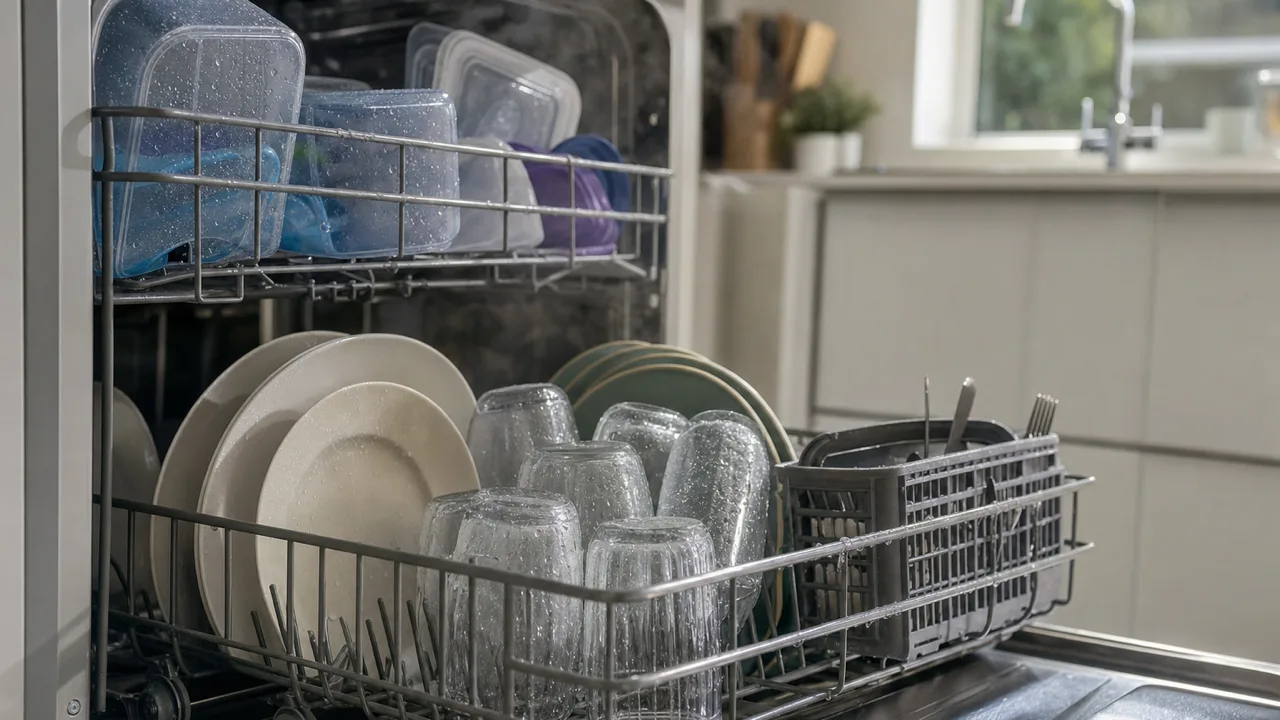
Eleven weeks old, and it hands back a load you have to towel off. That is the call, near enough word for word, three or four times a year, and it almost always arrives after two trips back to the shop and two people saying the machine is working as designed.
Here is the annoying part. The shop is right and you are right, at the same time. Nothing is broken, and something has genuinely changed since the machine it replaced. That is an unsatisfying thing to hear from a salesman, so here is the longer version, which is the one that actually helps.
The old machine had a heating element in the bottom that came on at the end and baked the load dry. The new one has no such element. It dries by holding the heat from the final rinse in a stainless steel tub, letting the water evaporate off the crockery and condense on the cooler tub walls, and then draining it away. No fan, no element, nothing to fail. Very efficient, and it works properly right up until you put a plastic container in it.
Why the plastics come out wet and the plates do not
Condensation drying runs on stored heat. A plate holds heat. A glass holds heat. A plastic takeaway container holds almost none, so it drops back to room temperature within a minute of the cycle ending, and any water on it just sits there.
That is not a fault and no repair will change it. If you have plastics on the top shelf and they come out wet while the china below is dry, your machine is doing exactly what it was designed to do.
The other one people get caught by is the cutlery basket. Spoons stacked nested into each other trap water in the bowl, every single time, on every machine ever made. Alternate them handle up, handle down, and half that complaint disappears.
Cups and bowls with a recessed ring in the base are the third. There is nothing to be done except tilt them, or lift them out last.
Rinse aid is not optional any more
This is the part that surprises people. On a condensation drying machine, rinse aid is not a luxury product to make glasses shiny. It is part of how the machine dries.
What it does is break the surface tension so the water sheets off instead of beading up. Beads sit there and evaporate slowly and leave a spot. A sheet runs off in seconds and there is nothing left to dry. Take the rinse aid out of a condensation drying dishwasher and its drying performance drops off a cliff, which is why the very first thing I do on one of these calls is open the flap next to the detergent door and look.
Half the time it is bone dry and has never been filled since the machine was installed. The all-in-one tablets have a rinse aid component but it is not the same as a full reservoir, especially in the Illawarra where the water is hard enough to leave a film on glass regardless.
If yours is full and the dishes are still wet, turn the dispenser setting up. There is a small dial or a menu setting on most machines, usually running one to six, and installers almost always leave it wherever the factory set it.
The habits that matter more than the machine
Open the door at the end. Not wide, just crack it and pull the top basket out ten centimetres. The steam leaves, the residual heat finishes the job, and a load that was damp at the beep is dry in fifteen minutes. Most machines beep and then sit sealed for hours while somebody is at work, and a sealed hot box full of steam does not dry anything.
Some newer models do this for you with a motorised door that pops open at the end. If yours has that and the door is not opening, that is a genuine fault and worth a call, because the whole drying strategy depends on it.
Do not run the eco or quick cycle if you want dry dishes. Both cut the final rinse temperature, and less heat in means less heat stored means a wetter load. The normal or auto cycle is the one that dries.
And do not overload. A plate leaning against a plate has a wet face between them and no airflow. Machines are rated for a number of place settings and it is not a suggestion.
When it actually is a fault
Enough hedging. There are real faults behind wet dishes and here is how to tell them apart from the above.
If the load comes out cold, not just wet but genuinely cold to the touch, the machine is not heating at all. On a machine with a flow-through heater that is usually the heater or its thermostat, and it will normally show up as poor cleaning as well, because detergent needs heat to work. The dishes coming out dirty guide covers that side of it.
If the machine has a drying element and it has stopped working, you will notice the change happen. Everything was dry, now nothing is, nothing else about the machine changed. That is a part, and it is usually a reasonable one.
If the rinse aid reservoir empties in a fortnight, the dispenser flap seal has failed and it is dumping into the wash. If it never empties at all and you know it is full, the dispenser has stuck shut. Both are small parts.
If there is water sitting in the base at the end of the cycle, you do not have a drying problem, you have a drainage problem, and the load is wet because it has been sitting over a puddle. Start with a dishwasher that will not drain instead, because the filter in the base is behind most of those.
And if the inside smells as well as being wet, the residual moisture is doing what residual moisture does. That one is covered in why your dishwasher smells.
Before you decide it is a dud
The honest summary is that machines built for the energy and water ratings dry more slowly than machines built in 1998 did, and there is a trade you have made whether anyone told you about it or not. You use a lot less power and water, and you crack the door at the end.
That said, if a machine is genuinely underperforming inside its first year, do not let a shop wave you off with "working as designed" before someone has actually looked at it. Your rights under the consumer guarantees sit alongside the manufacturer's warranty and they do not expire when the warranty card says so. The other thing worth doing on an older machine is keeping up with the maintenance, and there is a note on getting a longer life out of a dishwasher that covers it.
We repair every major brand of dishwasher across the Illawarra and South Coast, and the fault list for them is on our dishwasher repair page. A technician diagnoses and quotes before starting, and the assessment fee is $125 across the Illawarra and $145 further out. Book a repair or call 02 4229 3777.
If you do ring about wet dishes, tell me on the phone whether the load comes out hot or cold. That single detail decides whether I am bringing a part or bringing an explanation.