Thirroul, a wet Thursday, and the woman who met me at the door had already decided her dishwasher was finished. Two years old. Cleaned the plates perfectly well. But every time you opened it you copped a waft of something that had crawled in there and died, and she and her husband had been to Harvey Norman on the weekend to price up a replacement.
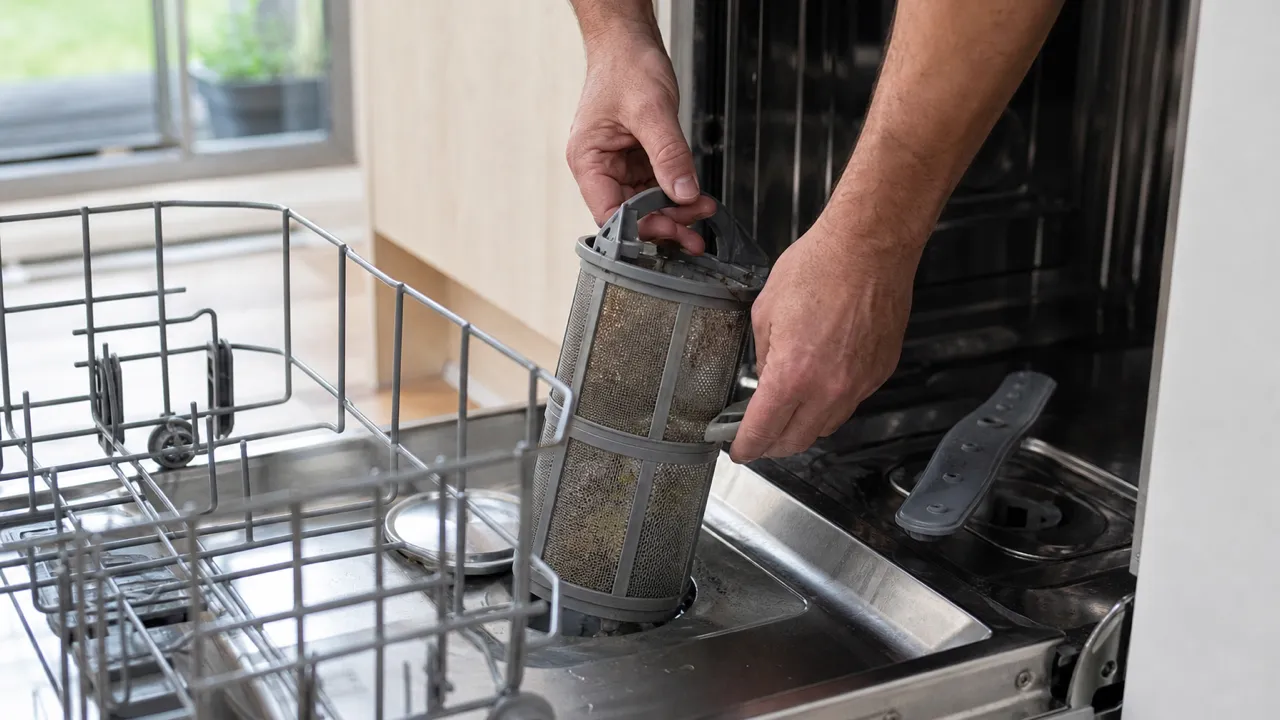
The filter had never been taken out. Not once. Two years of pasta, rice and the odd olive pit, sitting in a plastic cup at the bottom of the machine, warm and wet, going about its business.
I rinsed it under the tap in about ninety seconds. That was the whole job. She was mortified and I told her what I tell everybody, which is that the manual mentions it on page 34 and nobody has ever read page 34.
The filter, which is the answer most of the time
Open the door, pull the bottom rack right out, and look at the floor of the machine. There is a cylinder sticking up, usually with an arrow or a padlock symbol on it. Twist it anticlockwise a quarter turn and it lifts out, and underneath there is a flat mesh screen that also lifts out.
Take the lot to the sink. Hot water, a bit of detergent, an old toothbrush on the mesh. If you have never done it, brace yourself, because what comes off is not pleasant and the smell gets worse before it gets better.
Put it back and make sure it locks. A filter that is sitting loose lets food straight through to the drain pump, which turns a two-minute chore into a job for me.
Once a fortnight is about right for most families. Once a week if you scrape rather than rinse.
The spray arms and the bit under the door
While the racks are out, spin both spray arms with your finger. They should turn freely. Then look at the little holes along them, and hold one up to the light if you can get it off, because most of them unclip or unscrew by hand. A bit of seed or a splinter of bone will block a hole, and a blocked hole means a patch of the machine never gets washed, which means food sits there.
The other spot people miss is the rubber seal around the door and the flat lip below it, right at the bottom where the door meets the tub. Water does not reach that lip during a cycle. Wipe it with a cloth and you will usually find a grey line of grease. Same with the cutlery basket, which collects sludge in the bottom of each compartment.
Cold cycles are half the problem
Eco and quick cycles are popular for the obvious reason, and I have no argument with the power bill. But they run cooler and shorter, and fat does not shift at 45 degrees. It goes down the hose a little way, cools, and coats the inside of the pipe. Months of that and the smell is coming from the drain hose, not the machine.
So run a hot cycle with the machine empty every few weeks. Longest, hottest programme your model has, dishwasher cleaner or a cup of white vinegar in the base, no detergent. It scours the hose out. If your household mostly runs eco, make it monthly.
Detergent matters here too, and we went through the powder-versus-liquid argument in what manufacturers actually recommend. Short version for odour: the cheap all-in-one tablets often leave more residue behind than they shift.
Rinse aid is worth topping up as well. It is not marketing. Water sheets off the load instead of beading, things dry properly, and a dishwasher that dries properly does not go musty between runs. Same principle as leaving the door ajar overnight, which costs nothing and is the single easiest habit to pick up.
When the smell is a real fault
If the filter is spotless and it still stinks, check whether there is water sitting in the bottom of the tub after a finished cycle. A puddle in the sump means it is not draining, and stagnant water at room temperature smells within a day. That is a different problem and we cover it in a dishwasher that will not drain.
The usual culprit is the drain hose under the sink. It needs a high loop, up near the underside of the benchtop, before it drops into the waste or the trap. Without that loop the hose sags and holds a puddle of dirty water permanently, and worse, sink water can siphon back into your machine. A lot of these were installed badly by whoever fitted the kitchen. Anything past the machine's own hose is plumbing, so the waste connection under the sink is a licensed plumber's job, not a Saturday project.
Sometimes it is the non-return valve or the drain pump itself, blocked with a bit of glass or a fruit sticker. That one is ours.
And if the smell is more burning than rotting, stop using it and ring someone. Hot plastic or an electrical smell from any appliance means you turn it off at the wall and leave it off.
Is it worth keeping?
Filters, spray arms, hoses, pumps and door seals are all cheap enough to be worth doing on any machine that is otherwise sound. A control board failure on a twelve-year-old budget unit is where I start suggesting you spend the money elsewhere, especially since a newer model will use noticeably less water and power over its life. The running-cost figures for dishwashers make that case better than I can.
If it failed early, do not let anyone tell you the warranty period is the end of the conversation either. Consumer guarantees under Australian law run for as long as the goods should reasonably have lasted, which for a decent dishwasher is a lot more than two years.
There is more on getting the years out of one in extending your dishwasher's lifespan. Washing machines get the same smell for much the same reasons, and that fix is in clearing the smell out of a front loader.
If you would rather someone else did it
We repair dishwashers on every major brand from Helensburgh through Wollongong and down the coast to Nowra. Blocked pumps, dud heating elements, drain faults, door seals, the lot.
Nothing gets touched until you have a price in front of you. The assessment fee pays for the diagnosis, $125 anywhere in the Illawarra, $145 if you are further down the South Coast, and the quote lands before anyone picks up a spanner.
Two things worth having ready when you book a repair or ring 02 4229 3777: the brand, and whether there is water sitting in the bottom of the tub. That second one decides what goes on the van.