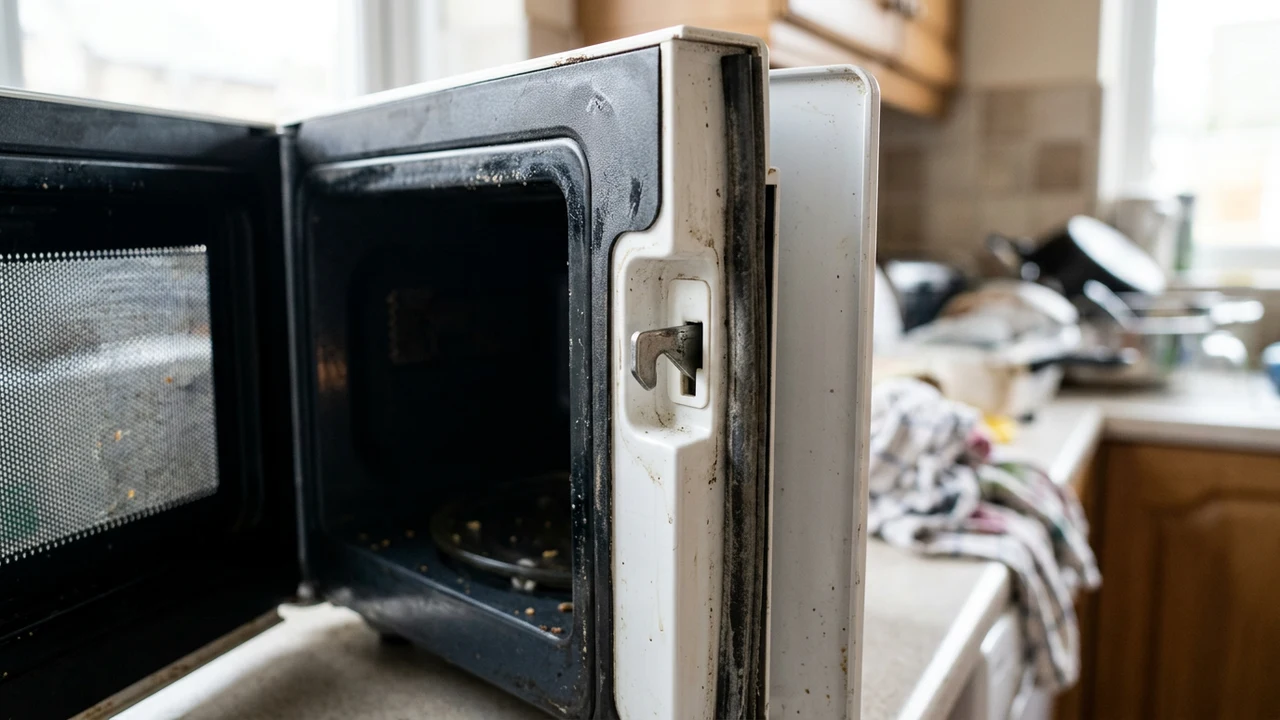
A microwave turntable that has stopped turning is usually a mis-seated plate, a worn plastic coupling or a failed turntable motor. The microwave still heats, but the food cooks unevenly: a hot edge on one side and a cold centre on the other. It is one of the cheapest microwave faults to fix, because every part involved is small.
Why has my microwave turntable stopped turning?
The turntable is driven by a small motor under the floor of the cavity. A plastic coupling pokes up through the floor, the glass plate sits on that coupling, and a roller ring underneath the plate keeps it level as it turns. If any one of those three is out of place, worn or broken, the plate stops rotating.
In order of how often we find them:
- The plate or roller ring is sitting wrong. After washing, the plate goes back one notch out, or the roller ring is not seated in its track.
- The drive coupling is worn or cracked. It is plastic and takes the load of every spin. When its teeth wear down, the motor turns and the plate stays still.
- The turntable motor has failed. The coupling is intact and nothing is jammed, but nothing turns when the microwave runs.
- Something is jamming the roller ring. Spilt food, a bit of crockery or a roller wheel that has seized.
What can I check at home first?
Take the plate and the roller ring out, look at the cavity floor and put them back in the right order. This takes a minute and sorts the most common cause.
- Lift out the glass plate and the roller ring. Wipe the floor of the cavity and the ring's track, because dried-on food in the track is enough to bind a roller wheel.
- Look at the coupling in the centre of the floor. The plate should lock onto it. If the teeth are rounded off or the coupling is cracked, it needs replacing.
- Refit the roller ring, then the plate, making sure the plate's centre engages the coupling and not just sits on top of it.
- Run it for ten seconds with a cup of water in it and watch the plate. Never run a microwave empty.
Some microwaves are flatbed models with no turntable at all, and a few have a plate that is meant to be removed for large dishes. Check the manual before assuming a fault.
How do I tell a worn coupling from a dead motor?
With the plate off, start the microwave for a few seconds, then look at the coupling. A coupling that turns freely when the unit runs means the motor is fine and the problem is above it. A coupling that stays still while the unit runs points to the motor, or to a coupling that has stripped on its shaft.
You can also hear the difference. A faint humming or ticking from under the floor while nothing moves usually means a motor working against a jam or a stripped coupling. Complete silence from under the floor while the fan and light run normally points to a failed motor.
Do not open the case to check. A microwave holds a high-voltage capacitor that stays charged after it is unplugged, and on most units the turntable motor sits behind the same cover as the high-voltage parts. Checking the motor means removing that cover, which is a technician job.
Is it worth repairing?
Usually yes. Turntable motors and drive couplings are small parts (see microwave repair), and a repair on a benchtop microwave is one of the cheaper microwave jobs. The assessment is $125 across the Illawarra and $145 further out on the South Coast, and the technician quotes before any repair goes ahead.
On a built-in or over-range microwave the case for repairing is stronger again, because the replacement has to fit the existing cabinet cut-out. If the unit is a budget benchtop model and the quote comes close to the price of a new one, the repair-or-replace call is yours. How we weigh repair against replacement sets out what we look at.
If the repair is on a product that is only a few years old, you may also have rights under the Australian Consumer Law whatever the manufacturer's warranty says. NSW Government's consumer guarantees page says that, depending on whether the problem is minor or major, you may have the right to a repair, replacement or refund. Authorised brands include Samsung, LG and Electrolux, and and we repair in and out of warranty. Genuine parts are carried for those brands.
When should I stop using the microwave?
Stop if the plate is cracked, if there is sparking or arcing inside, or if there is a burning smell. A turntable that has stopped turning is a nuisance rather than a hazard, but a stationary plate under full power concentrates heat in one spot. Stir or rotate the dish by hand halfway through until it is repaired.
If the microwave is also not heating or will not start, those are different faults. See microwave runs but the food is still cold, microwave won't turn on and microwave sparking inside.
Book online or call 02 4229 3777 with the make, the model number and whether the coupling turns when the microwave runs.