Fridge Not Cold but Freezer Working? Here's Why
Written by Jozo, Lead technician
Updated

It is one of the more confusing appliance faults: the freezer is rock solid, but the fridge below it is barely cool and your milk is turning. The reassuring part is that if the freezer still works, the compressor and refrigerant are almost certainly fine. The problem is usually with how cold air is moving from the freezer into the fridge.
Why is the fridge warm when the freezer still works?
Because the two compartments share one cooling system. The freezer holds the evaporator that makes the cold, and the fridge only gets cold air that is pushed across from it, so a warm fridge under a cold freezer means the transfer has stopped, not that the cooling has failed. That comes down to the fan, the damper or a sheet of ice sitting in the airflow path.
The checks below run from the free ones to the ones that need a technician, and the first two clear a fair share of calls.
Can a fridge stop working while the freezer still works?
Yes. On most frost-free fridges the freezer makes the cold and a fan pushes some of it into the fridge section through a vent, so the fridge can warm up while the freezer stays frozen. The usual causes are blocked vents, ice over the airflow path, a failed evaporator fan or a faulty defrost system. A fridge that is warm and a freezer that is also failing points to a different fault, such as the compressor or the sealed system.
- Freezer solid, fridge warm: airflow, fan or defrost. Start with the vents and a defrost.
- Both warming: a sealed system or compressor fault, which needs a technician.
- Fridge only slightly warm, food spoiling early: check the door seal and the temperature dial before assuming a fault.
How your fridge actually cools
In most modern fridges, cold air is produced in the freezer and then blown into the fridge compartment through a vent by a small fan. If that airflow is interrupted, the freezer stays cold but the fridge warms up. That points you straight at the likely causes.
Check the vents are not blocked
Overpacking the fridge or freezer, especially near the vents at the back or top of the fridge section, can block the cold air from getting through. Move items away from the vents and give it a few hours to recover.
Look for iced-up airflow
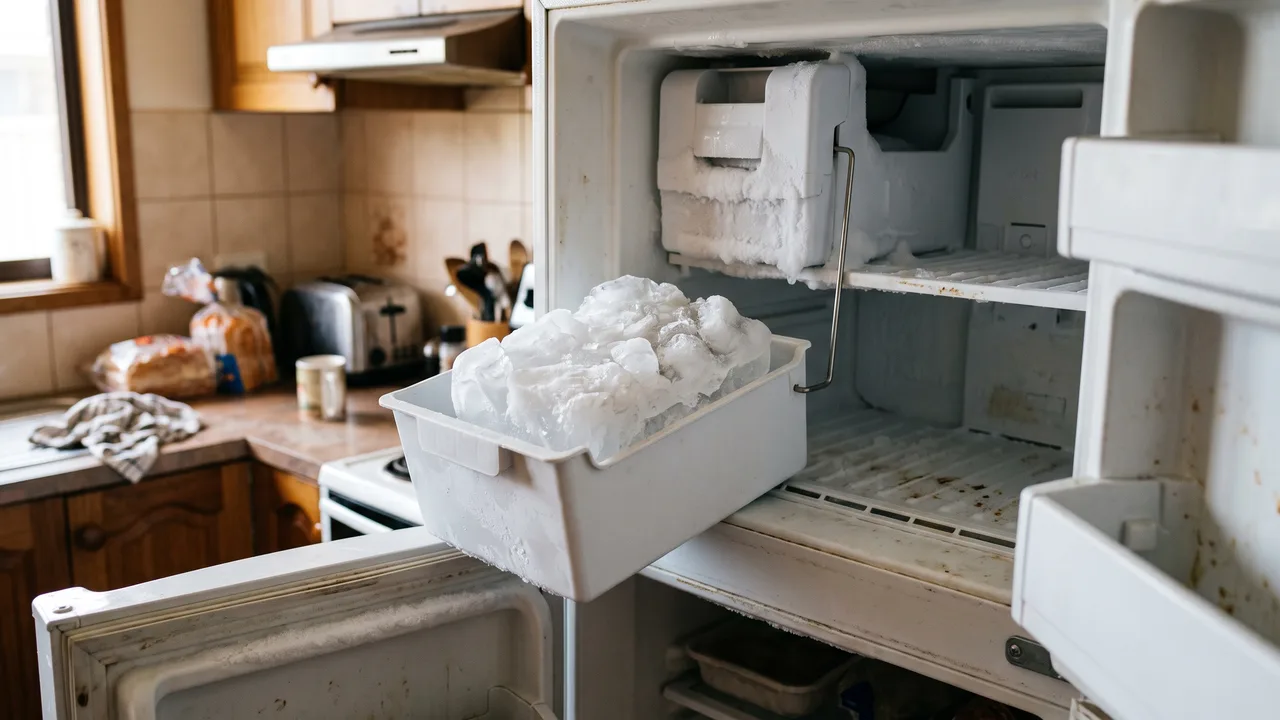
Frost building up around the vent or on the back panel is a classic sign of a defrost problem. If the defrost system is not clearing frost properly, ice slowly seals off the airflow path. You can confirm this by emptying the fridge and freezer, switching the appliance off for 24 hours to let it fully defrost, then turning it back on. If it works again but fails a few days later, the defrost system needs attention.
Check the door seals
Run your hand around the fridge door while it is closed. If you feel cool air escaping, or the seal is cracked or loose, warm air is getting in and the fridge cannot hold temperature. A poor seal makes the whole system work harder for a warmer result.
Check the fan
Listen for the evaporator fan running when the fridge is closed (press the door switch to keep it running). If that fan has failed, cold air never reaches the fridge section even though the freezer is perfectly cold.
Which part is usually to blame
Once the easy checks are done, the fault tends to be one of four parts. The evaporator fan can stop or slow down, so the cold stays in the freezer. The damper, a small flap in the duct between the two compartments, can stick shut and starve the fridge of air. The defrost heater, timer or thermistor can fail, so frost builds on the coil until it seals the airflow. Or the temperature sensor in the fridge section can read wrongly and tell the control board to stop sending cold.
Frost on the back wall of the freezer is a strong sign of the defrost group. A freezer that is oddly colder than ever while the fridge warms points to a damper or a sensor. We can tell which on site with a meter, which is why a guess followed by a parts order is not the way we work.
Protect your food while you wait
A fridge that sits warmer than 5 degrees for a few hours is a food safety issue, so act on it while you sort out the repair. Keep the door shut as much as you can. Move milk, meat, leftovers and anything that spoils fast into the freezer compartment if there is room, or into an esky with ice packs. Leave a cheap thermometer sitting in a cup of water mid-shelf overnight and you will get a truer reading than the dial gives.
If the fridge has been warm for a long stretch, throw out perishables rather than gamble on them. Do not refreeze anything that has thawed fully.
When it is worth repairing
A fan motor, a damper or a defrost sensor on a fridge in good condition is usually a sound repair. CHOICE puts fridge life at 10 to 11 years and says a fridge is usually cheaper to replace than repair from 8 to 9 years, which we set out in our repair versus replacement guide. So a 5 year old fridge with a dead fan is almost always worth fixing, while a 12 year old one needs a straighter conversation.
When a quote comes in, compare it with the price of a comparable new fridge, and remember that Australian Consumer Law guarantees can apply to a younger fridge that fails early.
What to tell us when you ring
A few details speed things up: the brand and model number from the label inside the fridge, whether the freezer is still fully frozen, whether there is frost or ice at the back, and whether you can hear the fan. Our assessment fee is $125 in the Illawarra and $145 further out on the South Coast, with a quote before work starts and a 3 month workmanship guarantee. You can read more on our fridge repair page.
When to call a professional
If defrosting fixes it only temporarily, or the fan is not running, the fault is likely a defrost heater, thermostat, sensor or fan motor. These need testing and replacement by a technician.
Wollongong Service Company repairs fridges and freezers across the Illawarra and South Coast. Before your food spoils, book a repair or call 02 4229 3777.