One zone dead on a ceramic cooktop, and the part that usually did it
A bloke at Bulli replaced a perfectly good cooktop because one zone had stopped working. Four figures for the unit, plus an electrician to disconnect the old one and wire the new one in, and the fault was a switch worth about forty dollars sitting under the benchtop.
He did not ring anyone first. He looked at it, decided a dead zone meant a dead cooktop, and went to the shop. I only found out because he called me eighteen months later about the oven underneath and mentioned it in passing. I did not have the heart to make much of it.
Ceramic tops are the ones people give up on early, and I think it is because you cannot see anything. A gas burner tells you what it is doing. Induction throws a code at you. A ceramic zone just sits there being black glass, and there is no obvious way in.
There is, though. You just have to watch it.
The glow test, which costs nothing
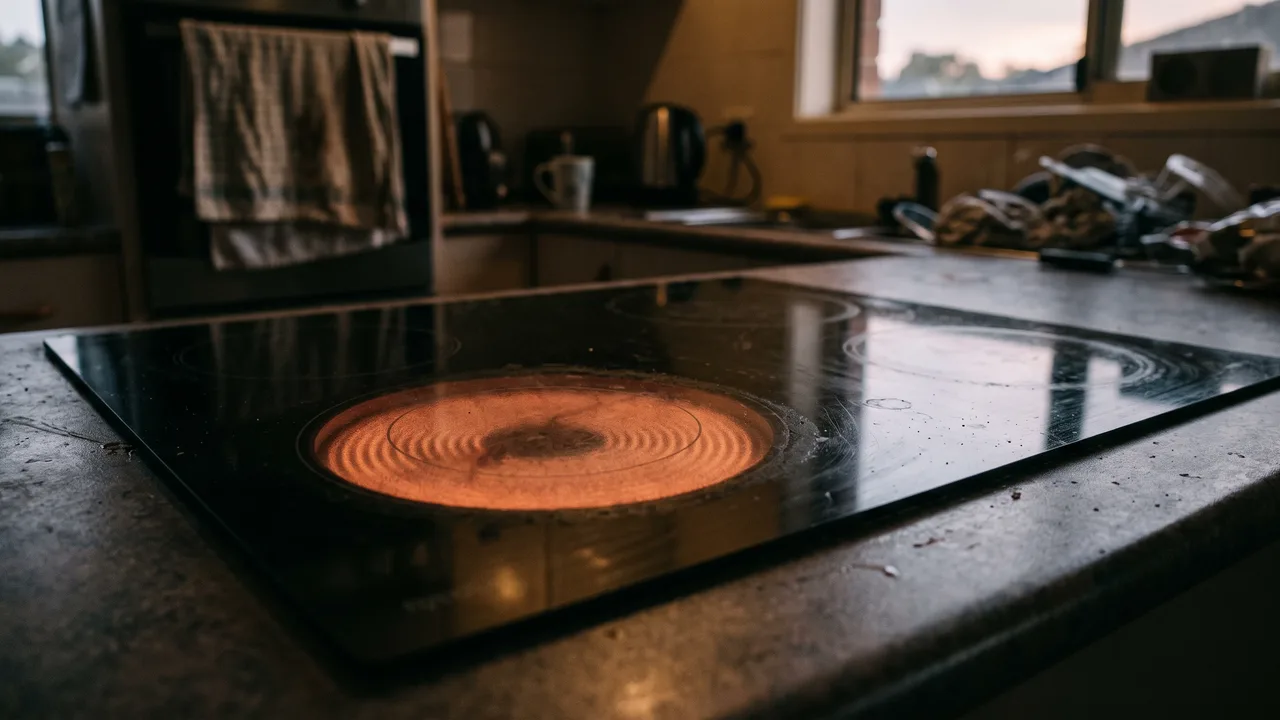
Wait until dusk, turn the kitchen light off, put the suspect zone on full, and watch it through the glass for about four minutes. Then do the same on a middle setting. Then do a working zone the same way so you have something to compare against.
Underneath that glass is a coiled element sitting in a shallow dish, and it does not run continuously the way a heating element in an oven does. It is driven by a thing called an infinite switch, which is a little bimetal device that clicks the element on and off. On a low setting it might be on for four seconds and off for twenty. On full it is on nearly all the time. That pulsing is the whole reason a ceramic zone can hold a simmer, and it is also why half the "faults" I get called about are not faults.
So here is what the glow tells you.
Never glows at all, on any setting. The circuit is open somewhere. That is either the element itself burnt through or the switch failing to close, and it is not something you can pick from the kitchen side of the glass.
Glows on high but not on the lower settings. That is the switch. The element is clearly fine, because it lights up when the switch is holding closed, and what has failed is the bit that is supposed to cycle it.
Glows constantly on every setting, including low. Also the switch, contacts welded shut, and this one is worth acting on rather than living with. A zone that cannot turn itself off will run hotter than the design allows and it will keep doing it whether or not there is a pan on it.
Glows normally but the food will not cook. Not an electrical fault at all. Read on.
The pan is the fault more often than anyone believes
Radiant heat only crosses to the pan where the pan is actually touching the glass. A base that has bowed even slightly, which happens to cheap stainless and to anything that has been taken off a hot zone and run under the tap, sits on its rim with a gap in the middle. The zone glows away perfectly, the outside of the pan gets hot, and the middle takes forever.
Put a ruler across the base of the pan you are complaining about. If you can see daylight under the middle of it, you have found your fault, and it is not the cooktop.
The other one is size. A small saucepan on a large zone is heating a ring of glass around it as much as it is heating the pan, which is slow and wasteful and reads to the owner like a weak element.
When the whole thing is dead
One zone out is a component. Everything out is supply, and that is a different conversation.
Most ceramic cooktops in this area are hardwired rather than plugged in, on their own circuit at the switchboard. Have a look for a tripped breaker first. If it trips again the moment you put a zone on, stop there and leave it off, because that is an element that has gone to earth and repeated resetting is not doing you any favours.
The odd one is a freestanding stove where half the cooktop works and half does not, or the cooktop is dead and the oven is fine. That usually means one supply leg has been lost rather than the appliance failing, and it is a switchboard problem before it is an appliance problem. Either way, anything on the fixed wiring side of the appliance is licensed work. In NSW you must hold an electrical licence to do any electrical wiring work, regardless of the cost or type, and that includes disconnecting a hardwired cooktop to get it out of the bench.
Cracked glass is the one that ends the conversation
If the glass has a crack in it, turn the cooktop off at the wall and leave it off.
The element sits directly under that surface with nothing between them, and a crack is a path for anything that spills. Boil a pot of pasta over onto a cracked top and the water goes straight down onto a live element. That is not a "keep using the other zones and see how it goes" situation, and there is no repair for it either. The glass and the frame are usually a single assembly, and on most models the price of that assembly is close enough to a new cooktop that people replace.
Two things crack them, in my experience. A dropped pan, which everyone expects, and thermal shock, which nobody does. A cold wet cloth thrown onto a zone that has just been turned off will do it. So will sugar. Which brings me to the next bit.
Sugar and plastic, and why you clean it hot
Anything sugary that boils over, jam, syrup, a marinade, has to come off while the top is still warm. So does melted plastic, and so does foil.
Leave any of them to cool and set, and they do not just sit on the surface, they bond into it. Getting them off cold takes a scraper at a low angle, and you will often find pitting underneath where the sugar has taken a bit of the glass with it. That pitting is permanent, it collects the next spill worse than the smooth glass did, and it is how a cooktop starts looking twenty years old at eight.
Warm, not hot, a scraper blade held almost flat, and a ceramic cream afterwards. Not a scourer, not a green pad, not a spray-and-wipe with grit in it.
What is worth repairing and what is not
The good news on ceramic tops is that the two parts that actually fail are cheap. A radiant element and an infinite switch are both inexpensive, both generic enough that availability is rarely the problem, and both replaceable with the cooktop still in the benchtop on most models.
What stops a repair is the same thing that stops it on an oven: a touch-control board or a printed fascia on a discontinued model. Once those are gone they are gone, and we will say so at the assessment rather than order something on the chance.
The coastal thing worth mentioning is the underside. Cooktops in beach houses and holiday places between Thirroul and Gerringong that sit unused for months come up with corrosion on the element terminals and the earth connections, and that shows as intermittent zones long before anything fails outright. If a zone works some days and not others, that is where I would look.
And before you write an older cooktop off as simply worn out, it is worth thirty seconds on the national product recalls register with the model number in hand, because a recalled appliance is often repaired or replaced by the manufacturer at no cost.
The other two kinds of cooktop
If yours is not radiant, the fault list is different. An induction cooktop that will not work is usually the cookware or a locked panel rather than a fault, and a gas cooktop that clicks but will not light is nearly always a burner cap sitting crooked or a blocked electrode. Both are worth reading before you book anything.
Booking a repair
We repair ceramic, electric, induction and gas cooktops across Wollongong, the Illawarra and the South Coast, domestic only, and we work on them in the benchtop rather than pulling them out. If the oven underneath is playing up as well, we will look at both on the one visit, because they are separate appliances with separate elements and it is common for one to be fine while the other is not.
We are a family-owned authorised repairer for all the major brands we service and carry parts for them, so we handle this in warranty and out. If yours is still under warranty, have your proof of purchase handy when you book. The assessment fee is $125 across the Illawarra and $145 further out on the South Coast, and you get the repair price before any work starts. Book a repair or call 02 4229 3777.
Do the glow test first, though. It takes four minutes and it tells me more on the phone than any description of the symptom ever has.