Why is my fridge wet on the outside?
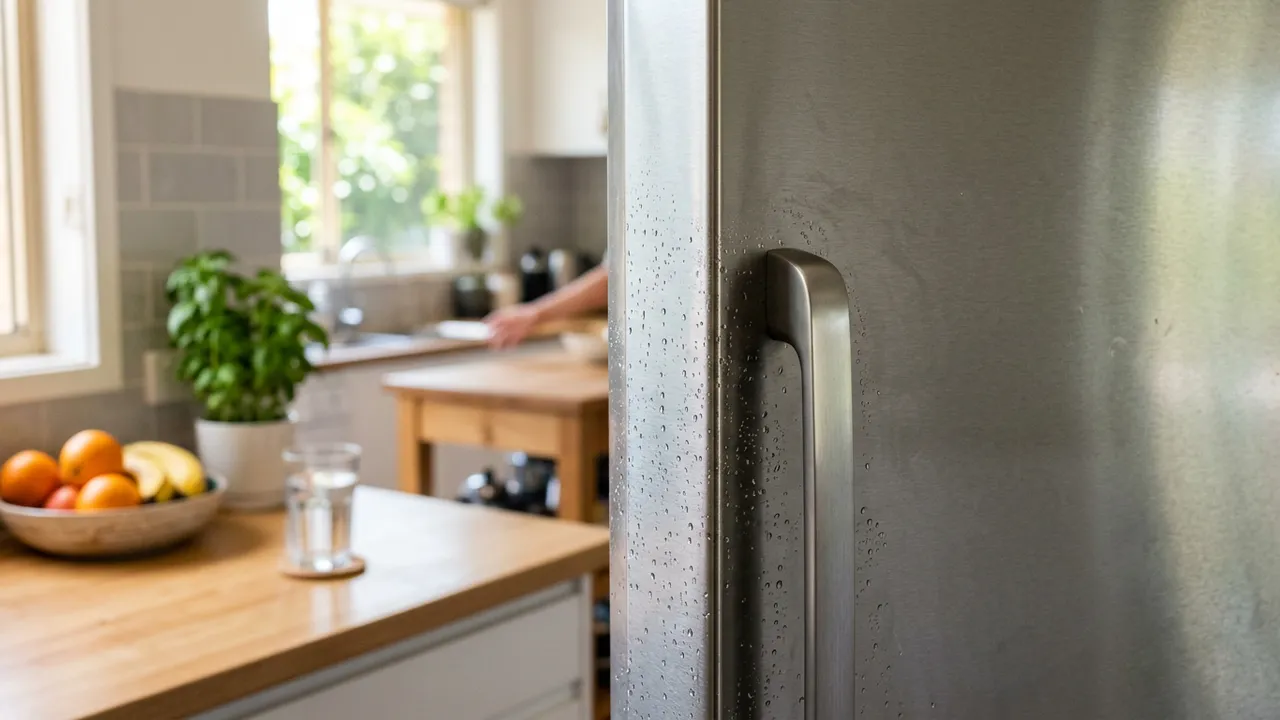
Moisture on the outside of a fridge is usually humid air condensing on a cold cabinet surface, which can happen in muggy weather without any part failing. It points to a fault when the sweating is worse than before, sits mainly along the door edge, or comes with a fridge that runs constantly or loses temperature.
Is moisture on the outside of a fridge normal in a Wollongong summer?
Yes, a small amount of condensation on the outside of a fridge is normal during higher humidity, especially in coastal homes. Opening the doors often makes droplets heavier because cold air spills out around the frame, so taking items out in one go and closing the door quickly limits the buildup.
On the Illawarra coast, historical station averages from Wollongong University (station 068188, 1972 to 2008, now closed) show mean 9am relative humidity rising from an annual average of 65% to 70% in January, 73% in February and 70% in March. Mean 3pm relative humidity moves from 61% across the year to 68% in January and 69% in February.
That seasonal jump explains why a cabinet that stays dry through winter can mist over in February. Illawarra summers are humid enough that a marginal door seal shows up here first, so heavy beading along one seam or water running down the door still warrants checking.
Could a loose fridge door seal cause moisture on the outside?
Yes, a dirty, misaligned or damaged gasket lets cold air leak out and warm air seep in, leaving condensation along the door edge. Check first that nothing inside obstructs the gasket or stops the door closing flush.
Wipe the rubber seal and the frame it meets with a warm, damp cloth and mild dish soap, repeating monthly so grime does not break the seal. Press any drooping section back into place and check for splits, warping or damage.
To test the grip, shut the door on a sheet of paper or a banknote and pull, working right around the door. Slight resistance means the seal holds; a spot that slips out easily, or frost or condensation along the interior edge near the seal, points to an air gap. Our guide explains how to test and replace a fridge door seal in full.
Misaligned doors can fail that test even when the rubber is sound, so adjust the levelling screws at the base until the fridge sits evenly and the doors pull shut square.
How much clearance does a fridge need around the cabinet?
A household fridge needs at least 50 mm (2 inches) of clearance at the back, top and sides so heat from the rear motor can escape. Pushing the cabinet hard against a wall or into a tight alcove traps warm, humid air around the casing and makes the cooling system work harder.
Inside, keep food 2 inches clear of interior air vents so chilled air circulates evenly.
A damp, poorly ventilated corner collects more exterior condensation than an airy kitchen. Along the coast, fridge condenser coils clog faster too; see our note on how salt air affects appliances.
What temperature should a home fridge stay at to keep food safe?
NSW Food Authority food safety advice is to keep home fridges below 5°C at all times and freezers at -18°C or below. Exterior droplets on their own do not mean food has spoiled, because a cabinet can sweat in humid air while staying cold inside.
Food-poisoning bacteria grow best between 5°C and 60°C, so check the temperature regularly with a fridge thermometer rather than guessing from the outside panels.
Once a thermometer confirms both compartments hold those temperatures, food remains safe while you sort out humidity, clearance or a dirty seal. If the fridge climbs above 5°C, or water pools on interior glass shelves, see our guide on water inside the fridge and the defrost drain.
When should you book a fridge repair for exterior condensation?
Book a repair if exterior moisture returns after you have cleaned the gasket, levelled the doors and confirmed 50 mm of clearance, or if the seal is damaged. Signs the fridge needs a technician include:
- A door gasket that is worn, warped or damaged, or still fails the paper test after cleaning and levelling.
- Heavy sweating along the door edge alongside frost buildup or a fridge that runs constantly.
- Cabinet temperatures above 5°C, or unusual noises alongside the moisture, covered in what your fridge's noises are telling you.
Wollongong Service Company has repaired appliances across the Illawarra and South Coast since the 1980s, covering Helensburgh through Wollongong, Dapto and Shellharbour to Nowra and the Shoalhaven. We are an authorised repairer for AEG, Asko, Beko, Blanco, Bosch, Electrolux, Euromaid, Fisher & Paykel, Haier, Hisense, Kelvinator, LG, Omega, Samsung, Smeg and Westinghouse, using genuine parts with a warranty on both parts and labour. If the same fault comes back within the warranty period, we return and put it right at no further cost.
Our fridge repairs cover household fridges and freezers, including model-specific door seals, which are one of the cheapest repairs on a fridge. The sealed system (compressor and refrigerant gas) is licensed refrigeration work that we do not repair, and owners should not open the back panel or touch the sealed system. We also do not take on commercial kitchen equipment, cool rooms or display cabinets.
Our assessment fee is $125 across the Illawarra and $145 further out on the South Coast, and we give you the repair price before any work starts. Small jobs come to the assessment plus a cheap part, around $60. The bigger fridge repairs come to roughly $500 to $600 all up.
Have the fridge's model number ready, call us on 02 4229 3777 to speak with someone in Wollongong, or book a repair online.